Updated July 2026
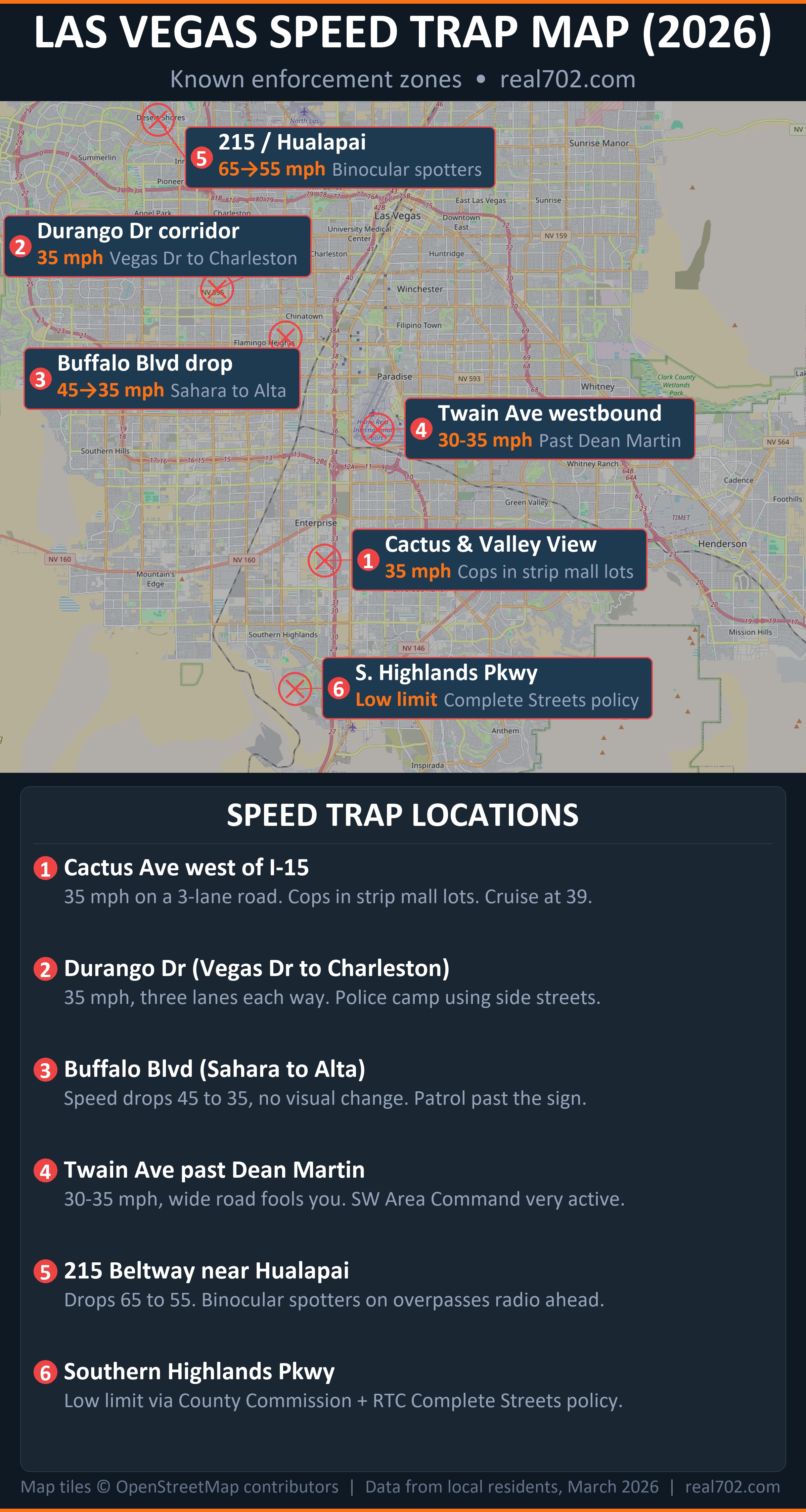
Quick Answer: The worst speed traps in Las Vegas are on Cactus Ave west of I-15 (35mph on a road that feels like 45), Durango between Vegas Dr and Charleston, Buffalo Blvd from Sahara to Alta, and the 215 near Hualapai where it drops from 65 to 55. Cops use strip mall parking lots, side streets, and even binoculars on overpasses. Set cruise control, learn the speed drops, and save yourself $200+.
Las Vegas Speed Traps: A Local's Guide to Not Getting a Ticket
Las Vegas speed traps catch more drivers every year precisely because the roads look faster than they are. After a few months in the valley, the scene becomes familiar: red and blue lights in the rearview mirror, a driver pulled over on a wide, three-lane road where the limit is 35 but every visual cue reads 45. Most people passing by think the same thing: that could be me. If you drive certain stretches of the southwest valley regularly, it will be you unless you know where to pay attention.
This isn't about complaining that cops enforce traffic laws. They should. Las Vegas has already recorded 48 traffic fatalities in 2026, and there's a valley-wide enforcement sting running through the end of March. The roads here are genuinely dangerous, and speed is a factor in a lot of those deaths.
But there's a difference between legitimate enforcement and roads where the posted speed limit is so far out of step with the road design that even careful drivers get caught. These are the spots where locals have learned, usually the hard way, to set their cruise control and leave it alone.
The Big One: Cactus Ave West of I-15
Among all Las Vegas speed traps, this is the most notorious. Cactus Ave west of I-15, especially the stretch near Valley View, is a 35mph zone on a road that has three full lanes in each direction. It looks like a 45. It feels like a 45. East of I-15, it actually is 45. But west of the freeway, it drops to 35, and the enforcement is relentless.
Cops park in strip mall lots along Cactus, tuck into side streets, and sit in unmarked spots near Valley View waiting for the steady stream of drivers who haven't adjusted. People who live at Cactus and Decatur will tell you they've watched this play out daily for nearly a decade. It's not occasional enforcement. It's a permanent fixture.
The official explanation from Clark County Public Works Traffic Management Division (responding to a December 2025 inquiry) is that Cactus Ave has undeveloped sections that cause the road to widen and narrow abruptly, and the lower speed limit is a safety measure. That's a reasonable explanation on paper. In practice, you're driving on a wide, well-paved, three-lane road, and the 35 feels like it belongs on a residential side street, not a major east-west corridor.
The local survival tactic is simple: set cruise control to 39 mph and leave it there from I-15 to Decatur. Not 40. Not 42. Thirty-nine. That gives you a small buffer above the limit without triggering enforcement. It feels painfully slow, and every lifted truck behind you will be annoyed, but that's their problem.
If you need to move east-west in this area and speed matters, locals recommend Somerset Ave as an alternative. It runs roughly parallel to Cactus a bit further north, and while it's not faster by design, you won't have a cop sitting in every other parking lot along the way. Silverado Ranch runs parallel to the south at 45mph, which actually matches what the road looks like.
This is Spring Valley territory, by the way, and if you're considering moving to this part of the valley, factor the Cactus situation into your daily commute math. It's a great area to live in, but you'll be driving this road constantly, and getting a ticket on it is practically a rite of passage.
Durango Between Vegas Drive and Charleston
Durango south of Vegas Dr through to Charleston is another three-lane-each-way road posted at 35mph. Same story as Cactus: the road design suggests a higher speed, and the enforcement takes advantage of the gap.
Police camp on this stretch regularly. There are enough cross streets and parking lots along Durango to give them plenty of cover, and the road is long enough that drivers tend to drift up to 42-45 without realizing it. By the time you spot the cruiser parked in a commercial driveway, your speedometer has already told the story.
The fix is the same as Cactus: cruise control, low 30s, and patience. This stretch connects several residential neighborhoods to commercial areas, so you'll be on it often if you live in the northwest side of Spring Valley or the edges of Summerlin.
Buffalo Boulevard: The Invisible Speed Drop
Buffalo Blvd between Sahara and Alta has one of those speed limit transitions that you can miss entirely if you're not looking for it. The road drops from 45 to 35 with no obvious change in the road's width, lane count, or character. It just... drops.
There's no school zone, no construction zone, no residential neighborhood that suddenly appears. The road looks the same at 45 as it does at 35. But the sign is there, and if you miss it, the officer parked a quarter mile south of it will be happy to point it out.
This is the kind of speed trap that isn't really a "trap" in the deliberate sense. It's just bad road design meeting enforcement. The speed limit change doesn't feel intuitive, so people blow through it. And because it's a known issue, there's often a patrol car nearby during peak hours.
Twain Westbound Past Dean Martin
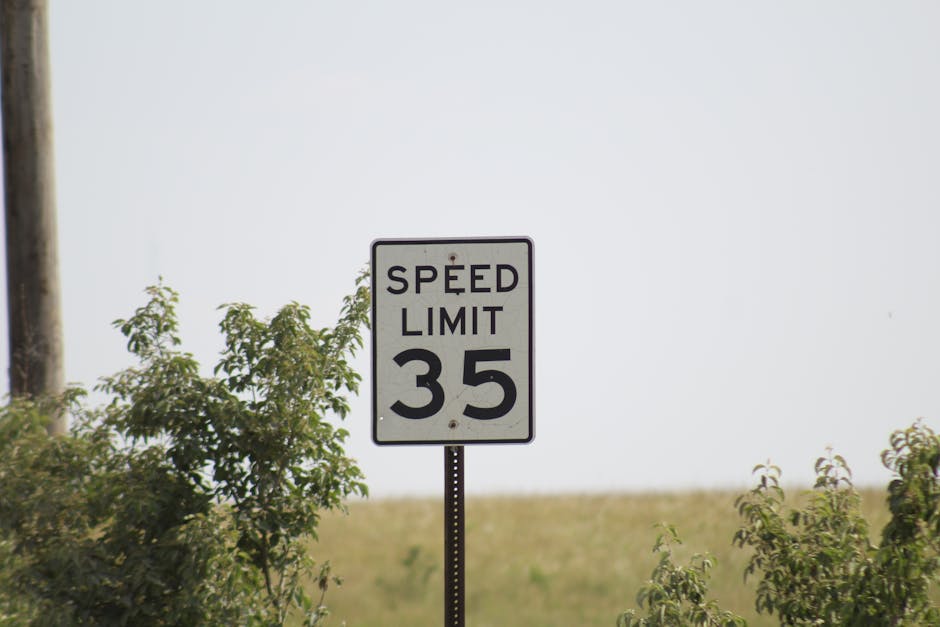
Twain Ave heading west past Dean Martin Blvd is posted at 30 or 35 the entire way. It's a wide road with good visibility, and it connects to some of the busiest corridors in the valley. You feel like you should be going 40-45, but you absolutely should not.
Part of the heavy enforcement here ties back to a genuine problem: street racing. Valley View and Dean Martin have a known street racing issue, especially late at night, and the police presence in this corridor is partly a response to that. During the day, though, the enforcement is focused on regular speeding, and the wide lanes make it easy to creep up without noticing.
This is one of those stretches where the Southwest Area Command (LVMPD) is particularly active. That command reportedly has the fastest response time of any LVMPD command in the city. Take that however you want, but it means there's almost always a unit nearby.
The 215 Near Hualapai and Lone Mountain
The freeways have their own version of this problem. The 215 Beltway near the Hualapai and Lone Mountain exits drops from 65 to 55, and the enforcement setup is more sophisticated than a cruiser parked on the shoulder.
Locals have reported officers stationed on overpasses with binoculars, logging vehicles that are speeding and calling ahead to units positioned further down the road. That same relay setup has been documented at St. Rose Parkway and I-15 as well. By the time you clear the spotter's position, the unit downstream already has you in mind.
If you're commuting along the 215 through this section, watch for the speed change signs. The drop from 65 to 55 is well-marked, but it's easy to miss when you're in flowing traffic and everyone around you is going 68. That's the other problem with freeway speed traps: the flow of traffic is often 5-10 over the limit, and you're keeping pace with everyone else. When enforcement decides to pull someone out of that pack, it's basically a lottery of who's in the wrong lane at the wrong time.
This part of the 215 runs along the western edge of Summerlin and connects to the northwest valley. If you're commuting from Centennial Hills or the far northwest side toward the Strip or the airport, you pass through this zone daily.

Southern Highlands Parkway
Southern Highlands Parkway has a lower speed limit that catches newer residents off guard. The limit here isn't some holdover from an older era or an undeveloped section causing safety concerns. It was set with County Commissioner approval as part of the Regional Transportation Commission's Complete Streets initiative.
Complete Streets is an RTC program designed to make roads safer for pedestrians, cyclists, and drivers by reducing design speeds. In practice, it means the speed limit on Southern Highlands Parkway is lower than what the road geometry would normally dictate. Clark County Public Works has confirmed that this speed limit will not be changed.
Whether you agree with the philosophy or not, the practical reality is the same: know the limit, respect it, and understand that enforcement will be consistent because the county specifically chose this approach for this road.
Henderson: A Different Kind of Enforcement
This article has focused mostly on LVMPD Metro territory, but Henderson deserves its own mention. Henderson PD has a reputation among valley residents for being noticeably more aggressive on traffic enforcement than Metro. Multiple long-time locals confirm this independently.
The difference isn't about speed traps specifically. Henderson tends to enforce more consistently across the board: speed, lane changes, rolling stops, expired tags. If you're used to the relatively relaxed enforcement of Metro's jurisdiction and then cross into Henderson, you might be surprised by how quickly you see blue lights for something you've gotten away with for years on the other side of town.
This isn't a knock on Henderson PD. Their roads are generally well-maintained, their neighborhoods are safe, and consistent enforcement is part of why. But if you're moving to the valley and choosing between Henderson and, say, Spring Valley or Summerlin, it's worth knowing that the traffic enforcement culture is different.
The Current Enforcement Climate (July 2026)
As of July 2026, the valley-wide traffic enforcement sting that launched in March continues to produce elevated police presence on main streets and highways. The stated reason is the 48 traffic fatalities recorded so far this year, which puts 2026 on pace to match or exceed recent years.
This means the speed traps listed above are even more active than usual. The sting isn't permanent, but the underlying enforcement patterns are. These are the same roads where cops have been sitting for years. The sting just adds more officers to the rotation.
How to Not Get a Ticket
None of this is complicated. It's just about knowing where the problem spots are and adjusting.
Use cruise control. This is the single most effective thing you can do. On Cactus, Durango, Buffalo, and Twain, set it to 2-3 mph over the posted limit and leave it. Your foot will naturally push the speed up on these wide roads. Cruise control won't.
Learn the speed limit transitions. Most tickets happen right after a speed drop, not in the middle of a 35mph zone. It's the transition from 45 to 35 that gets people. Know where they are on your daily routes.
Watch for the parked cruisers. Cops in the southwest valley park in strip mall lots, side streets, and commercial driveways. On the freeways, they use overpasses and on-ramp shoulders. Once you start looking, you'll notice them everywhere.
Don't rely on Waze or Google Maps speed alerts. They help, but they're not always accurate in real time, and they don't always show the parked units on surface streets. Your eyes are better.
Stay right. On multi-lane roads, the left lane tends to move faster because that's where the aggressive drivers are. If you're in the right lane doing the speed limit, you're less likely to be the one who gets pulled over, even if you're slightly above the limit. Cops generally pull the fastest car in the flow, and that's almost always in the left lane.
If you're new to the valley, drive your daily routes on a weekend when traffic is lighter and you can pay attention to the posted speed limits without someone tailgating you. Note where the limits change. Make a mental map. It takes one afternoon and it can save you hundreds of dollars in tickets. Las Vegas roads also knock your alignment out faster than most cities, especially around construction zones and the Spaghetti Bowl area. The Las Vegas tire and alignment guide explains what to watch for and how often valley drivers typically need service.
If you're still getting oriented to valley driving, the moving to Las Vegas guide covers everything else worth knowing about life here, from utilities setup to the full traffic and commute picture. Learning the roads before you need to rely on them is one of the cheapest investments a new Las Vegas driver can make.
More from Real702
- Las Vegas Traffic and Commuting: What Residents Actually Deal With
- Spring Valley: Affordable, Central, and Close to Everything
- Henderson Neighborhoods: Where to Live on the Southeast Side
- Summerlin: Master-Planned Living on the West Side
FAQ
What is the speed limit on Cactus Ave in Las Vegas? Cactus Ave west of I-15 is posted at 35mph, even though the road is three lanes in each direction and looks like a 45mph road. East of I-15, Cactus jumps to 45mph. The inconsistency is part of why so many drivers get caught. Clark County Public Works has stated the lower limit is due to undeveloped sections that cause the road to widen and narrow abruptly, and they have no plans to change it.
Why are there so many cops on Cactus and Valley View? Cactus Ave near Valley View is one of the most consistently enforced speed zones in the Las Vegas valley. The 35mph speed limit on a wide, multi-lane road means most drivers naturally exceed it, creating a steady stream of enforcement opportunities. Officers park in strip mall lots, side streets, and along Valley View to catch drivers in the 40-50mph range. The area falls under LVMPD's Southwest Area Command, which reportedly has the fastest response time in the city.
Is there a speed trap on Durango in Las Vegas? Yes. Durango Blvd between Vegas Drive and Charleston is posted at 35mph with three lanes in each direction. Police regularly camp on this stretch, using cross streets and commercial parking lots for cover. The road design suggests a higher speed, which is exactly why drivers get caught. If you're driving through this corridor in Spring Valley or toward Summerlin, set cruise control and stick to 37-38mph.
What are the worst Las Vegas speed traps in the valley? The most notorious Las Vegas speed traps are Cactus Ave west of I-15 (35mph, feels like 45), Durango between Vegas Dr and Charleston (35mph, three lanes each way), Buffalo Blvd between Sahara and Alta (speed drops from 45 to 35 with no obvious reason), Twain westbound past Dean Martin (30-35mph on a wide road), and the 215 Beltway near Hualapai/Lone Mountain exits (drops from 65 to 55 with binocular spotters on overpasses). Henderson PD also enforces more aggressively than LVMPD Metro across the board.
Do Las Vegas police use speed cameras or radar traps? Las Vegas does not currently use automated speed cameras. Enforcement is done by officers in marked and unmarked patrol cars, typically parked in strategic locations along roads with low speed limits relative to road design. On freeways like the 215 and I-15, officers have been spotted using binoculars on overpasses to identify speeding vehicles and radio ahead to units further down the road.
How much is a speeding ticket in Las Vegas? Speeding ticket fines in Clark County vary based on how far over the limit you were going. Generally, expect $200-$400+ for standard speeding violations, plus potential points on your license. Going 1-15 mph over the limit is a lesser offense, but 16+ over can result in significantly higher fines. Traffic school may be an option to dismiss points, but the fine itself usually still applies. The cheapest speeding ticket is the one you avoid by knowing where to slow down.
Keep reading
- Moving from Arizona to Las Vegas: What Actually Changes in 2026An honest comparison of Phoenix vs Las Vegas: taxes, cost of living, jobs, schools, and what Arizona transplants are surprised to find.
- Moving from the Midwest to Las Vegas: The Honest Culture Shock GuideWhat Midwest transplants actually experience moving to Las Vegas: climate adjustment, cost of living, community differences, and what no one tells you.
- Moving from Texas to Las Vegas: Honest Comparison for 2026Taxes, housing, weather, and job market compared. What Texas transplants actually experience when moving to Las Vegas in 2026.
- Best Moving Companies in Las Vegas 2026: Avoid Scams, Hire RightHow to tell a legitimate Las Vegas mover from a broker scam in 2026. The hostage load trick, summer heat logistics, and what real reviews actually tell you.