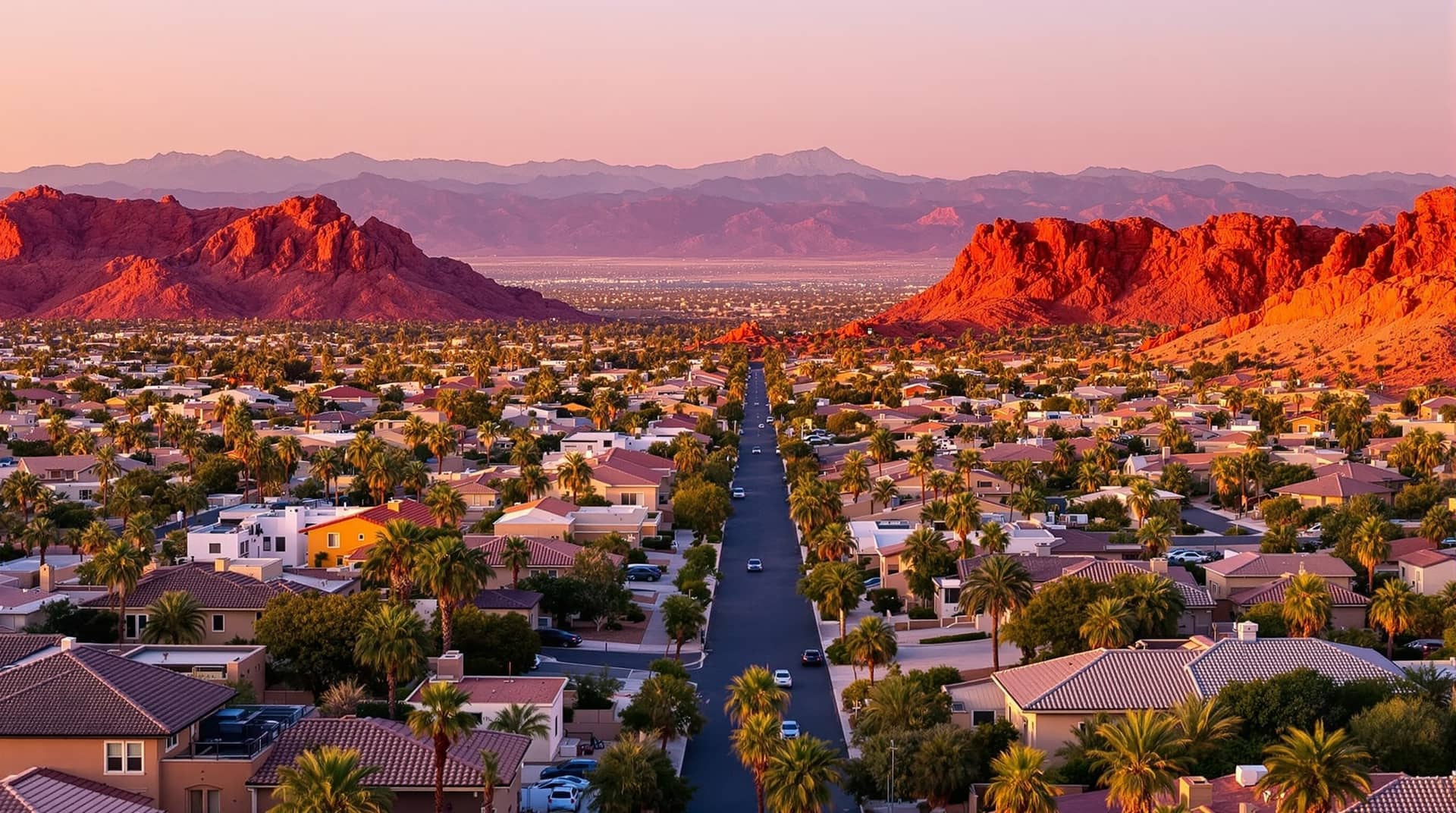
Quick Answer: Centennial Hills gives you Summerlin-quality construction at roughly $100k-$150k less, but you trade proximity to Red Rock, established amenities, and dining for a longer commute to the south valley. If your job is in the northwest or you work from home, Centennial Hills makes real financial sense. If you want the full package of amenities, trails, and community depth, Summerlin justifies the premium.
Summerlin vs Centennial Hills: The Northwest Valley Comparison
These two neighborhoods share a northwest Las Vegas address and a lot of superficial overlap: both have newer construction, active HOAs, good schools, and a family-oriented demographic. But they are meaningfully different places to live, and the choice between them usually comes down to one honest question: how much is your daily commute worth to you in dollars and time?
Centennial Hills occupies the far northwest corner of the valley, anchored near the US-95 and CC-215 interchange. Summerlin begins where Centennial Hills ends to the south and southeast, running along the western edge of the 215. They are adjacent. The drive from deep Centennial Hills to the eastern edge of Summerlin is 15 minutes. The difference in housing costs, commute position, and access to amenities is far larger than that drive time suggests.
Housing Costs
The price gap is the reason this comparison exists.
Summerlin:
- Established villages (3-4 bedroom): $550k-$750k
- Newer builds and premium villages: $800k-$1.2M
- Townhomes: $350k-$500k
- HOA: $150-$400/month with Summerlin Council master fee included
Centennial Hills:
- Typical 3-4 bedroom: $400k-$580k
- Newer 2010s-2020s planned community builds: $480k-$650k
- HOA: $100-$300/month
On comparable construction, Centennial Hills generally runs $100k-$150k less than Summerlin. That translates to roughly $500-$700/month less in mortgage payments at current rates, plus $50-$150/month lower HOA on average. The all-in monthly cost of living in Centennial Hills versus Summerlin in a similar-size home can be $600-$850 lower per month.
For a household with a $140k income, that difference is significant. For a household at $200k+, it matters less. Know your number before you fall in love with either neighborhood.
Commute Truth
This is where the two neighborhoods diverge most sharply, and it's the most honest reason to choose Summerlin at the higher price.
Centennial Hills to the Strip / south valley employers:
- Off-peak: 30-35 minutes via US-95 south
- Morning rush (7-8:30am): 40-55 minutes, and 60+ minutes is not unusual
- US-95 southbound from the CC-215 interchange is a known, consistent bottleneck every weekday morning
Summerlin (eastern edge, near the 215) to the Strip:
- Off-peak: 15-20 minutes
- Morning rush: 25-35 minutes
- The 215 east from Summerlin is a more manageable drive than US-95 south from Centennial Hills
The commute difference between deep Centennial Hills and eastern Summerlin to Strip-area employment is roughly 15-25 minutes each way. Over a year of five-day workweeks, that is 125-208 extra hours in the car. That is 5-8 full days of your life, annually, sitting on US-95.
Where Centennial Hills wins on commute: If your job is in the northwest valley, specifically near Losee Road industrial areas, Apex Industrial Park, or the US-95 corridor near Craig Road, Centennial Hills has a clear commute advantage over most of Summerlin. Nellis Air Force Base is also accessible without going through central Las Vegas.
For remote workers, the commute variable largely disappears, and Centennial Hills becomes a much stronger financial argument.
Home Age and Build Quality
Both areas skew toward newer construction compared to the valley average. But there are differences worth noting.
Summerlin has a wider range of housing ages. Established villages from the early 1990s exist alongside communities built in the 2010s and 2020s. This means more variety in style and price, but also older construction in the legacy villages that may need updating. A 1995 Summerlin home is 30 years old.
Centennial Hills was developed almost entirely post-2000, with most of its housing stock from 2005-2020. You are more likely to get newer mechanicals, updated floor plans, and modern construction standards. Fewer deferred maintenance surprises on roofing, HVAC, and plumbing in a 15-year-old home versus a 30-year-old one.
If newer construction is a priority and you want to avoid the maintenance budget that older Summerlin stock can require, Centennial Hills has a structural advantage here.
Schools
Both areas are served by CCSD, and both outperform the valley average. This is not a clear differentiator.
Summerlin schools: Palo Verde High School is the established public anchor. Elementary schools in The Trails, The Paseos, and Summerlin Centre are among the top CCSD schools by test score performance. The quality is consistent.
Centennial Hills schools: Centennial High School performs well on state assessments. Elementary and middle schools in the area have solid ratings. The area also draws families specifically because of the school reputation, which has been building for years.
The honest answer: the school quality difference between these two areas is marginal for most families. Both offer meaningfully better options than the valley average. Check the specific school zone for the address you're buying before assuming the neighborhood-level reputation applies to every school within it.
Amenities, Dining, and Retail
This is where Summerlin's maturity shows most clearly, and it is a meaningful lifestyle difference.
Summerlin has 30+ years of retail and dining development. Downtown Summerlin (the outdoor mall at Sahara and the 215) anchors a dense cluster of restaurants and shops. Rampart Boulevard has a restaurant corridor that includes genuinely excellent local spots like Black Sheep and Honey Salt. Grocery access is excellent: Whole Foods, Trader Joe's, WinCo, Smith's, and Costco are all within easy reach.
Centennial Hills has a developing but noticeably thinner dining and retail base. Ann Road and Tenaya Way have grocery options (Smith's is well-positioned). But Whole Foods and Trader Joe's require a drive to Summerlin. The restaurant scene is sparser; many Centennial Hills residents drive south to Summerlin for dining options they can't find locally. This is a real gap, and it will close as the area matures, but as of 2026 it is not closed yet.
If the quality and variety of nearby restaurants and shopping is part of how you evaluate a neighborhood, Summerlin wins this comparison by a wide margin. If you care most about grocery access for daily needs and mostly cook at home, Centennial Hills is adequately served.
Outdoor Access
Summerlin is adjacent to Red Rock Canyon. That is the sentence. The western edge of Summerlin trails lead directly into the Red Rock National Conservation Area for hiking and mountain biking. This is not a "nearby" amenity; it is an adjacent one. On a weekday morning you can be on a trail in 10 minutes from a Summerlin address.
Centennial Hills is further from Red Rock, roughly 20-30 minutes to the visitor center. It is also near the Las Vegas Wash and Sheep Range foothills with some outdoor access, but it does not have the proximity to Red Rock that Summerlin has.
For anyone who wants outdoor recreation as a regular part of life (not just occasional), Summerlin's location advantage here is real and persistent.
Community Feel
Summerlin has a more developed community identity. The villages, the Downtown Summerlin gathering point, and the decades of community building have created something that feels like a place. The Summerlin Trail system gives residents a shared outdoor infrastructure. Community events and programming have had 30 years to build.
Centennial Hills is newer and has less institutional depth. It feels more like a collection of HOA developments than a single coherent community. That will likely change over time. Right now, it has the anonymous character of a suburb that hasn't had time to develop personality yet.
Neither of these descriptions is a dealbreaker. Many people prefer the quieter suburban anonymity of newer development. Others specifically want the established community feel. Know which type you are.
The Verdict
Choose Summerlin if:
- Red Rock access matters to your actual weekly routine, not just as a theoretical perk
- You work in the south or central valley and will commute daily
- The dining and retail depth of an established community matters to your lifestyle
- You have the income to comfortably absorb the $100k-$150k price premium and higher HOA fees
Choose Centennial Hills if:
- Your job is in the northwest valley, near US-95 north, or you work remotely
- The lower purchase price meaningfully impacts your financial picture
- You prefer newer construction over established-but-older housing stock
- You are fine driving to Summerlin occasionally for dining and specialty grocery
For buyers being priced out of Summerlin, Centennial Hills is the strongest comparable alternative in the valley. The schools are good, the neighborhoods are safe, and the newer construction quality holds up. The commute and amenity gaps are real costs you should price honestly before committing.
Finding Water Damage Restoration in the Northwest Valley
Both Summerlin and Centennial Hills face monsoon season flash flooding risks alongside the typical plumbing failure risks of desert housing. Summerlin's older established villages have aging infrastructure; Centennial Hills' newer builds can develop foundation and drainage issues as the desert clay soil shifts. For Summerlin restoration, see the top-rated restoration contractors in Summerlin. For Centennial Hills, see the top-rated restoration contractors in Centennial Hills. For valley-wide options, VegasRebuild covers the northwest valley.
FAQ
Is Centennial Hills cheaper than Summerlin?
Yes, consistently by about $100k-$150k on comparable homes. A 3-4 bedroom in Centennial Hills typically runs $400k-$580k versus $550k-$750k in established Summerlin villages. HOA fees are also generally lower in Centennial Hills.
How far is Centennial Hills from Summerlin?
The two areas are adjacent. The drive from central Centennial Hills to the eastern edge of Summerlin is roughly 10-15 minutes. Despite their proximity, the commute difference to south valley destinations is significant because US-95 south from Centennial Hills is more congested than the 215 east from Summerlin.
Are schools better in Summerlin or Centennial Hills?
Both areas have better-than-average CCSD schools. Summerlin has a slightly longer track record of top-performing schools, including Palo Verde High School. Centennial Hills has Centennial High and solid elementary options. The difference is marginal for most families. Always check the specific school zone for any address before buying.
Which is better for outdoor activities, Summerlin or Centennial Hills?
Summerlin, and it's not particularly close. Summerlin's western neighborhoods are adjacent to Red Rock Canyon National Conservation Area. Centennial Hills has some outdoor access near the Sheep Range foothills but is 20-30 minutes from Red Rock. For regular hikers and mountain bikers, Summerlin's access advantage is meaningful.
Does Centennial Hills have a Trader Joe's or Whole Foods?
Not in Centennial Hills proper. Both are in Summerlin, roughly 15-20 minutes south. This is a real lifestyle gap for residents who rely on those stores. Centennial Hills' local grocery options include Smith's and Walmart on Ann Road and a Costco accessible near the 215.
Keep reading
- Henderson vs Green Valley Las Vegas: What the Difference Actually Is (2026)Green Valley is inside Henderson, but they are not the same. Honest breakdown of old Henderson, Green Valley, and newer Henderson developments for 2026.
- North Las Vegas vs Henderson: Honest Comparison for 2026North Las Vegas vs Henderson: real talk on affordability, safety, commute, and which one actually fits your budget and lifestyle in 2026.
- Spring Valley vs Summerlin Las Vegas: Which One Makes Sense for You? (2026)Spring Valley vs Summerlin: honest comparison of price, commute, HOA rules, housing quality, and who actually belongs in each neighborhood in 2026.
- Summerlin vs Henderson: Which Las Vegas Suburb Is Right for You? (2026)Honest comparison of Summerlin vs Henderson for locals: housing costs, commute, schools, HOAs, lifestyle, and who actually belongs in each place.